

Definition
Introduced as part of the Taxpayer Relief Act of 1997, Roth IRAs are individual retirement accounts, which provide investors with several significant advantages when compared to Traditional IRAs.
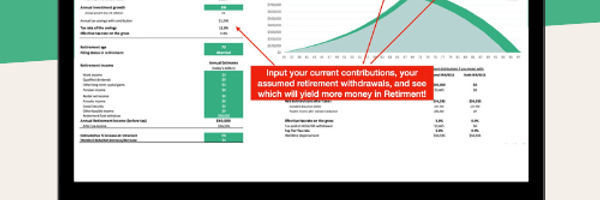
Roth IRA or 401k? This template will answer your questions.
With this template, you will get:
All DFY, simply add your details
Charts for comparison and clear answer
Easily update for any year (2023, 2024, 2025, etc…)

Explanation
Contributions to Roth IRAs are never tax deductible; however, if certain requirements are satisfied, distributions taken from Roth IRAs are tax-free. Unlike a Traditional IRA, the account holder is not required to take mandatory distributions. It's also possible to make contributions to a Roth IRA after reaching age 70 1/2.
In 2019, individuals can contribute to a Roth IRA as long as their Modified Adjusted Gross Income, or MAGI, is less than:
$137,000 for those filing taxes as single, head of household, or married filing separately (and not living with a spouse)
$10,000 for married filing separately, and not living with a spouse
$203,000 for those with a filing status of married filing jointly
The contribution limits for a Roth IRA are $5,500 in 2018 and $6,000 in 2019, or $6,500 and $7,000 with the catch-up contribution that applies to individuals age 50 or older.
Qualified distributions, or withdrawals, from an account must occur after age 59 1/2 and the plan has to be in existence, starting with the date the investor first contributed to a Roth, for at least five years. Non-qualified distributions may be subject to additional tax penalties.
There are also several withdrawal exceptions, allowing for penalty-free distributions before the age of 59 1/2. This holds true as long as the plan has been in existence for at least 5 years. If so, qualified distributions include:
Those made because the accountholder has become disabled
Distributions made to the beneficiary of the accountholder's estate
Up to $10,000 can be withdrawn to pay for a new home or rebuild a new home
Our article on Roth IRA Contribution Limits has up-to-date information on contributions, rollovers, as well as deduction phase out thresholds.
There are many benefits, but also a lot of circumstances where it might be a bad idea to set up a Roth IRA - visit our article to find out more.